
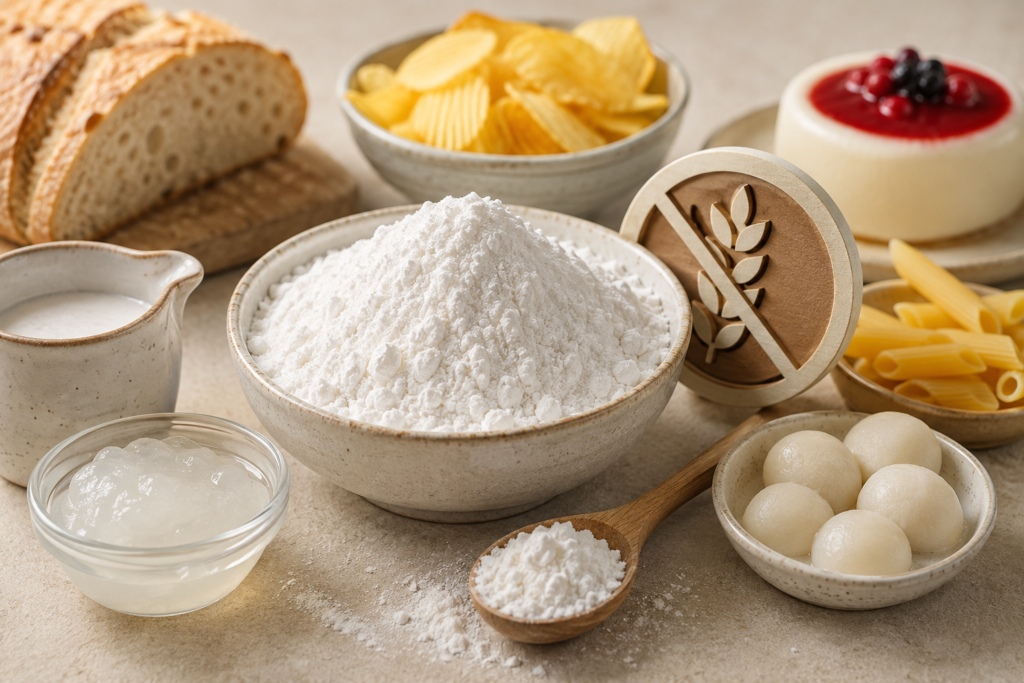
The development of gluten-free foods has become increasingly sophisticated. Today,
manufacturers are not only looking for ways to eliminate gluten from a recipe; they
are also trying to reproduce the qualities consumers expect from conventional foods.
Texture, processing behaviour, appearance and consistency can all be affected
when gluten is removed from a formulation. This is why the choice of functional
ingredients has become an important part of gluten-free product development.
Among the ingredients that can be considered, gluten-free wheat starch offers an
interesting combination of versatility and functionality.
More Than a Gluten-Free Ingredient
Wheat-derived ingredients can play different roles in food manufacturing, depending
on how they are processed and how they are incorporated into a recipe. For
companies developing gluten-free products, the objective is to identify ingredients
that provide the required technological properties while meeting the applicable gluten
requirements.
Sacchetto Starch offers a range of wheat derivatives for different industrial
applications, allowing manufacturers to evaluate solutions according to their specific
formulation and processing needs.
Gluten-free wheat starch is one of the options that can be considered when
developing products in which structure, consistency or texture are particularly
important.
What Happens When Gluten Is Removed?
Gluten has a major influence on the structure of many traditional foods, especially
baked products. It helps create a network that gives dough elasticity and allows it to
retain the gases produced during fermentation.
When gluten is absent, this structure has to be achieved through a combination of
other ingredients and processing techniques.
Starches can become particularly useful in this context. Their behaviour during
heating and processing can influence the texture and physical properties of the
finished food.
This is one reason why starches are frequently found in gluten-free formulations,
where they can work alongside alternative flours, hydrocolloids, proteins and other
functional ingredients.
Why Choose Wheat Starch?
At first glance, using a wheat-derived ingredient in a gluten-free product may seem
contradictory. The distinction lies in the processing and in the final gluten content.
Wheat starch intended for gluten-free applications undergoes processing designed
to separate and remove the gluten-containing protein fraction. When appropriately
produced and controlled, it can therefore be used in formulations that meet the
requirements for gluten-free foods.
The Codex Alimentarius standard specifies a maximum level of 20 mg/kg of gluten
for foods labelled as gluten-free. The Codex standard for foods for special dietary
use for people intolerant to gluten is an important international reference for
manufacturers and ingredient suppliers.
Where Can It Be Used?
There is no single type of gluten-free product for which wheat starch is suitable. Its
potential applications depend on the technical requirements of each formulation.
Bakery
Bread, rolls, biscuits and cakes are particularly demanding products because
consumers expect a pleasant crumb, good structure and an appealing mouthfeel.
A carefully designed starch system can contribute to these characteristics and help
compensate for some of the structural functions normally associated with gluten.
Pasta
Gluten-free pasta requires a formulation capable of maintaining sufficient integrity
during processing and cooking.
Starch can be part of a broader ingredient system designed to control texture and
improve the behaviour of the dough and finished pasta.
Sauces and Prepared Foods
The role of starch is not limited to bakery products. It can also be valuable in sauces,
creams, desserts and ready-to-eat foods, where viscosity and consistency are
important.
In these applications, the objective may be less about replacing gluten-related
functionality and more about achieving a specific rheological or textural profile.
The Importance of the Production Process
The performance of an ingredient cannot be separated from the way it is produced
and handled.
For gluten-free applications, manufacturers need confidence not only in the technical
specifications of the starch but also in its gluten status, consistency and traceability.
This is particularly important because gluten-free production requires effective
controls to prevent unintended contamination at different stages of the supply chain.
Ingredient specifications, analytical controls, manufacturing procedures and supplier
reliability therefore all contribute to the final result.
Formulation Is About Finding the Right Balance
A successful gluten-free product rarely depends on one ingredient alone.
The final characteristics are influenced by the interaction between starches, flours,
proteins, fibres, water, fats and other components, as well as by mixing, cooking and
processing conditions.
For this reason, gluten-free wheat starch should be viewed as a formulation tool
rather than as a universal replacement for conventional wheat ingredients.
Its value lies in the possibilities it offers manufacturers when designing a specific
product and looking for the right combination of functionality and performance.
Looking Beyond Traditional Gluten-Free Solutions
The evolution of the gluten-free market is encouraging manufacturers to move
beyond simple ingredient substitution.
Instead of trying to recreate a conventional recipe by removing one component, food
technologists can approach the formulation from a different perspective: identifying
the functions that need to be achieved and selecting ingredients capable of
delivering them.
Gluten-free wheat starch can form part of this approach, particularly in applications
where texture, structure, viscosity or processing behaviour are key considerations.
As the gluten-free sector continues to develop, the ability to select and combine
specialised ingredients will remain an important factor in creating products that
satisfy both technical requirements and consumer expectations.


More Stories
Emerging Market Trends: Navigating the Future of Consumer Behavior
Unlocking Tomorrow’s Profits: Emerging Market Trends to Watch in 2024
Fueling Tomorrow: The Latest Disruptors Reshaping Global Business